Friday, May 2, 2014

Bee and Flower

It’s mid way and the drawing of the White Dead Nettle flower is more or less compete. The leaves are deeply veined but this is not a “botanical” drawing so I don’t feel the need to draw every one of them, just give an impression of their complexity.

flower-b

It’s a time to assess the weight of various areas. The black bee and the two bugs are the main focus but I need some more weight at the top left. I am going to add some straight lines for an indication of the strange silver birch trees that form the background to Holme Fen and will add the distant bird hide which you can see when you look towards the wood from the info centre where the white dead nettles grow. maybe even a Highland cow.

bee-with-pencil--bg 

On the board..image about 10 x11 inches . Watercolour and pencil on Arches HP 300

Wednesday, April 30, 2014

The Pied Shieldbugs

Progress on the pied shieldbugs:
I re-positioned the main shield bug a little further away from the bee to give better balance to the piece. I had spent quite some time watching these tiny bugs and their interaction with other insects. It’s a fascinating micro world of uneasy relationships. Who is predator and who is prey? The shieldbugs did not seem to mind the bees apart from just having to get out of their way. I saw one tumble to the ground, knocked off a leaf by a huge bumble bee landing on a flower and bending the whole flower spike down. It flipped back like a catapult.

redrawofbug_thumb

bug-reposition

The painting of the bugs was fiddly as the largest one is only 1 inch long .

 beeand-r-bg

bugsolo

I love the way these tiny bugs get to the edge of a leaf and peer over. Bees and beetles do the same, as if contemplating the vista spread out before them. It’s a long drop but having wings must give you an extra sense of confidence.

bee-and-bugs-1-bg

The two bugs and the bee…. Next the flower and background. Lots of decisions to be made at this stage…

Monday, April 28, 2014

Back to the Bee

My Beautiful Beast this week continues with the Black Bee, Bombus ruderatus, Reading University and Friends of the Earth’s Iconic Bee for the East Midlands. (See my “A Fenland Bee” post)

By my last post here I had roughed out a design .. which I then changed. Such is life.
I decided to change the pose and design to include the odd little pied shield bug which I had found on the same plants at Holme Fen.

bbsketch-bg 
The foliage rough including the two bugs

I got down to painting the bee last week: (see “The Black Bee Continued”)

  new-bee-bg

Almost finished bee.

bbsketch-w-b

Sketch and painted bee, roughly combined to check composition. It will be about 10 inches square.

And I did a bit of extra shieldbug research. They are very interesting and attractive little “true” bugs, with a staged lifecycle going through at least 3 instars.

pied-shield-b

The neat, design-y shield bug instar stages.

This week I will be finishing the bugs and the foliage. There is another bee to come as well. A new drawing of a special Bombus hypnorum.

Monday, April 14, 2014

A Blog Break for Easter

Happy Easter to you all.
Sue and I are having a couple of weeks off. I have some commercial work to do but will be back on the 28th April.
And, as spring really gets going, there is so much gardening and belated spring cleaning to do. Hopefully the odd Easter Egg will arrive too!

Meanwhile an Easter chick! A little moorhen sketch from a few years ago. Just a ball of fluff with big feet. Some things may be different in Florida but the moorhens are just about the same.

chick-bg

Sunday, April 13, 2014

He's behind you!!........

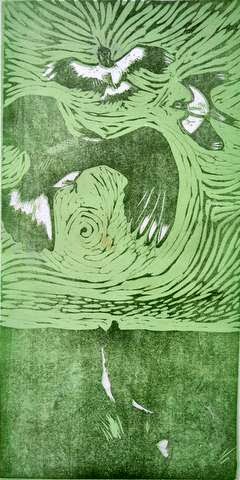
The reduction print process is always a challenge, but also interesting because you have to make up your mind one way or another.  Once an area has been cut away you can't replace it.

I was tempted to darken all of the Lapwings in the picture but finally decided to cut out the two smaller birds and keep them a lighter green tone so they recede into the background.

The Lapwing in the front seems as if they are just about to pounce on the unsuspecting fox who is preoccupied with the other birds..........


The prints were all done by hand which gives the final piece a softness that would be difficult to achieve if using a press, however I think it will be interesting to see the difference so will try it and show you next time.......
 

Saturday, April 12, 2014

Foxes and Lapwings

As usual, things haven't turned out quite as I expected when I started thinking about my blog post for foxes. For some reason, I got drawn to the thought of how foxes and birds interact especially at this time of year when there are eggs to be found on the ground  as an easy meal for a hungry fox.  You may have seen the extraordinary display Lapwings [Vanellus vanellus]  put on to protect their nests and chicks if danger is close at hand.  We used to call them Peewits because of their call, and they are part of the Plover family.

They will try and distract the predator through noise and even attack  or try to lure them off by feigning a broken wing. I remember seeing that as a child but rarely get to see such behaviour these days although their numbers do seem to be increasing, which wouldn't be difficult as we  hardly saw any for several years.

I started off with an idea in mind of a fox being mobbed by Lapwings and drew a sketch onto my lino.
 
1st stage - Initial cutting of block to retain the white areas
 
 
2nd Stage -First hand print to check image


Next stage in reduction process, as Val has already mentioned, so aptly named suicide method as there's no going back!.....
 
 
2nd colour print, all done by hand using a baron so the image is quite light and textured but I like that.  Using a press produces a different kind of image, more uniform and stronger in tone which is useful but maybe not always what is required.
 
The next stage is to check whether further cutting is needed to let the light green tone show more and then I can move on to printing the final tone, black.  All very anxiety inducing but also wonderful because you just never know how it's going to turn out!

Wednesday, April 9, 2014

Foxes again......

With Spring in the air, my thoughts have turned to the possibility of seeing young fox cubs. It's been a warm [if very wet!] winter so I suspect the cubs are, by now, thinking about coming out for their first look at the world. They're born blind and deaf so their mother has a lot of caring to do in the first few weeks of their lives but when they're about a month old they are ready to take in their surroundings and they have to learn fast because a few short weeks later they will be weaned....


    Sketch of young cubs relaxing
 
Once their tails are fully grown they will be longer than half their body length and they [like most young of any species] enjoy playing with their siblings and learning lessons which will help keep them alive......


    Quick pencil study of cubs playing   


They are very agile throughout their lives and when fully grown are capable of jumping over high fences and even swimming through rivers if the need arises so are well adapted to their hunting life.

 
Working out ideas for painting of cubs playing in Holme Fen
 
Capturing the colours of the Red Fox [Vulpes vulpes] is not always easy as they very quite a lot, but the distinctive marking and bushy tail is usually recognised by most people.
 
Sketchbook page - watercolour study for fur and eye colour.....


Another study in watercolour
 
I shall be looking to put these ideas into a painting or series of paintings as well as another print....there is so much to learn about these fascinating creatures and I really hope that you get a chance to see them for yourself.......just follow the unmistakeable scent!